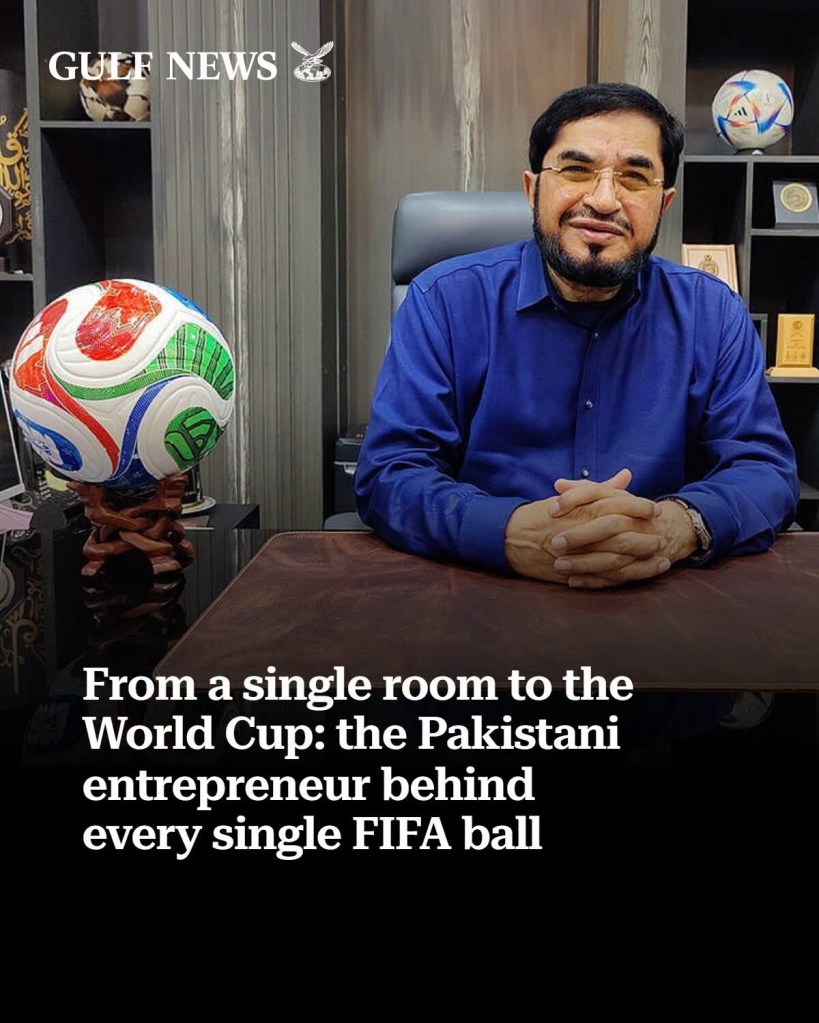
Every four years, the eyes of the world lock onto a single sphere. As the world’s greatest footballers step into packed stadiums, every thrilling goal, penalty, and bending free kick relies entirely on one vital element: the match ball. While global attention centers on the superstar athletes, the true architectural genius behind that ball resides thousands of miles away in Sialkot, Pakistan.
The incredible Khawaja Masood Akhtar, the visionary civil engineer who transformed a humble single-room operation into Forward Sports Private Limited—the powerhouse manufacturer that has powered consecutive FIFA World Cups.
An Unlikely Beginning: From Track to Pitch
Khawaja Masood Akhtar’s journey into the sporting industry was far from conventional. Armed with a technical degree in civil engineering, he began his career working a stable job with Pakistan Railways. However, destiny had a different route map. Prompted by his uncle, who ran a local sports business, Akhtar took a massive leap of faith.
“I never imagined I would end up manufacturing footballs,” Akhtar recalled. “I had no experience in the industry, but I had a technical mindset.”
In 1991, he branched out on his own to establish Forward Sports. Operating out of a single room with a modest workforce of just 20 employees, the company’s survival hung by a thread. In those initial years, they managed to produce a mere 1,000 balls per month, struggling to gain traction in an industry dominated by corporate giants.
The Turning Point: The Adidas Alliance
The defining moment for Akhtar’s enterprise came in 1994 when global sportswear titan Adidas partnered with the young factory. Fueled by strict discipline, precision engineering, and an unyielding commitment to quality, Forward Sports grew from a tiny startup into Adidas’s leading global supplier.
By 2014, the company hit the ultimate milestone: they were selected to manufacture the Brazuca, the official match ball for the FIFA World Cup in Brazil. The historic run didn’t stop there. Forward Sports went on to craft the Telstar 18 for Russia (2018), the Al Rihla for Qatar (2022), and most recently, the highly sophisticated, sensor-equipped Trionda ball for the 2026 World Cup across the United States, Mexico, and Canada.
Innovation Over Survival
How does a factory in Pakistan stay ahead of cutthroat international competition? To Akhtar, the answer is simple: relentless technological innovation.
Forward Sports successfully transitioned from traditional hand-stitched leather balls to state-of-the-art thermo-bonded technology in 2007. Over the years, Akhtar heavily invested in automation, laser-cutting systems, advanced German machinery, and AI-driven quality assurance. This commitment reduced their manufacturing lead times from an exhausting 90 days to a blisteringly fast 15 days. Today, the factory boasts an annual capacity of over 20 million footballs, churning out tens of thousands of balls daily.
Furthermore, Akhtar champion’s progress beyond just technology. Forward Sports has broken social boundaries in the region by employing over 1,300 female workers, offering them equal pay, healthcare, and dedicated transport facilities—proving that social empowerment is just as critical to growth as a strong supply chain.
A Legacy of Willpower
As showcased Akhtar remains grounded by his faith, his family, and his love for his country. Reflecting on his identity, he notes, “First, I am a human, then a Muslim and Pakistani. After that, I am a businessman.”

From a solitary, quiet room in Sialkot to the booming, electric stadiums of the FIFA World Cup, this extraordinary entrepreneur has put Pakistan at the heart of the beautiful game. His life story serves as a masterclass for aspiring innovators worldwide, proving the age-old adage he lives by: “Anything is possible when there is will. Where there is a will, there is a way.”
Imran Najeeb wrote
 Digital World Design & Marketing